The question raised by the CAD apartment is one specific to the Romanian contemporary suburb: designing the interior of a flat "poorly thought" from the point of view of architectural project, so as to become efficient and comfortable at the same time. For this reason we cannot use pretentious expressions (such as "spatial concept", "composition", "gesture", etc..) to describe the project. Our attitude was from the beginning a realist-functionalist one: we had to find room for storage where there was none planned in the architecture project of the building. There for a few changes have occurred in the layout, such as the repositioning of the wall between the bedroom and hallway in order to accommodate a second closet in the corridor, used as a "pantry", " dressing for winter clothes” and storage. Consequently, our design may be characterized by two major elements:
The first one, "the show" of custom-made furniture: avoidance of catalog accessories, precision in execution, making use of computer-assisted technologies (e.g. CNC) and maximum functionality (specific locations for each object stored, from the ironing board to the shoeboxes). Due to the small size of the apartment and to the fact that on two of its’ four sides the windows are full height, some unusual furniture layouts had to be designed: the multipurpose cabinet was conceived as a single element positioned in the centre of the living area, designed for easy transportation from the factory to the apartment and the in-situ assembly. It contains a double-access book shelve, multimedia, bar and a place for displaying flower arrangements. Also, the couch in the living room was designed to be configured in various ways depending on the activities that may take place in the living area. The table was attached to the central multimedia cabinet but can be removed in the event of a "small" party. The bed in the bedroom was fitted with drawers at the bottom, three on each side and night stands that can be retracted when not in use.
The second one would be the use of color - each area of the apartment received a specific color as follows: corridor - red, bathroom - violet-bordeaux, kitchen - olive-green and green in the bedroom. The living area and dining place became the meeting point of all the colors in the apartment.
Design Team: Paul-Mihai Moldovan, Florin-Vasile Lazar
Collaborator[s]:
Design Year: 2008
Status: Completed
Execution | Completion Year: 2010
Location: Cluj-Napoca, Romania
Net area: 54 sqm
Furniture Manufacturer: s.c. Terminus Prod s.r.l.
Text: Sabin Bors
Photographer[s]: Dacian Groza
coming soon...
Design Team: Paul-Mihai Moldovan, Florin-Vasile Lazar
Collaborator[s]: -
Design Year: 2011
Status: Completed
Execution | Completion Year: 2014
Location: Cluj-Napoca, Romania
Gross area: 192 sqm
Text: ateliercetrei
Photographer[s]:
Designed to meet the demands and needs of a young lady, Apartment AB is designed in a modular system in which the game of spaces and colors draws a steady line in a deliberately eclectic style. Built in a four years time frame the apartment breathes two styles from whose balancing results a lively, relaxed and airy space.
Located on an upper floor, on the eastern side of an '80s apartment building, the apartment covers a surface area of 65 square meters where the white painted walls contribute to a uniform lighting of the space to highlight the playful colors chosen by the client and the contrast between various furniture systems. As with other projects signed by ateliercetrei, the furniture is defined as being object designed, built in an uniform and defining style.
The colors of the furniture are in a balanced dialogue with the walnut floor. The ceiling has soffits for drapes and curtains which were deliberately chosen to be as "heavy" as possible to thus create an eclectic rapport with the space and the furniture. The hall wardrobe includes all the storage modules to free up space in the apartment.
Both bathroom and bedroom have decorative elements designed with the customer - the floral wallpaper from the bedside, to decorative ceramic tiles with incrusted crystals, carpets and curtains, the space offers privacy and a feminine ambience perfectly integrated to the modular concept. The same modular character is enhanced by the use of 30x60 cm and 10x10 cm ceramic tiles in the bathroom and the kitchen, which enter into direct dialogue with the overall design.
Apartment A.B. is defined by an eclectic functionalism that redraws the internal frames to streamline the spatial living. Efficient use of light and interior space in order to aerate the space, the effort to create continuity at both a formal and material level, or the ability to integrate contrasting decorative motifs put the apartment in a dynamic equilibrium, simple and functional, modulated by the daily needs of the client. The main ergonomic focus, drawn by the furniture from the living area, offers a unique perspective on alternative ways of conceiving and drafting an area without sacrificing practicality or aesthetics. It represents a possible definition of this lively space, as an overview of housing and as a way to imagine the space beyond its physical constraints and limitations.
Design Team: Paul-Mihai Moldovan, Florin-Vasile Lazar
Collaborator[s]:
Design Year: 2008
Status: Completed
Execution | Completion Year: 2010
Location: Cluj-Napoca, Romania
Net area: 65 sqm
Furniture Manufacturer: s.c. Terminus Prod s.r.l. | s.c. Salice Comprod s.r.l.
Text: Sabin Bors
Photographer[s]: Serban Bonciocat, Zsolt Kilin
5070 is a tea and coffee table that we began developing while we were architecture students. It evolved to what it is today in about seven years of design development, improvements, enhancements etc.
It consists of two modules. A smaller mobile module [408x540x220mm] which has a set of four embedded wheels. It allows the stacking of books, magazines, and whatever else one might have in a living room... The mobile module stands underneath a bigger one [500x700x300mm] and in can be rolled out to expand the serving surface when needed. A set of guides make sure that when one underneath the other the two modules have a distance between their edges equal to their thickness.
Design Team: Paul-Mihai Moldovan, Florin-Vasile Lazar
Collaborator[s]: Mihai Rosca
Design Year: 2005
Status: Completed
Material[s]: Veneered MDF with wooden trims
Technique[s]: Hand crafting
Manufacturer: ateliercetrei
Text: ateliercetrei
Photographer[s]: Dacian Groza
Design Team: Paul-Mihai Moldovan, Anamaria Moldovan, Simina Nicoleta
Collaborator[s]:
Design Year: 2021-2022
Status: Concept Design
Execution | Completion Year: -
Location: Cluj-Napoca, Romania
Gross area: 972 sqm
General Contractor:
Text: ateliercetrei
Photographer[s]: -
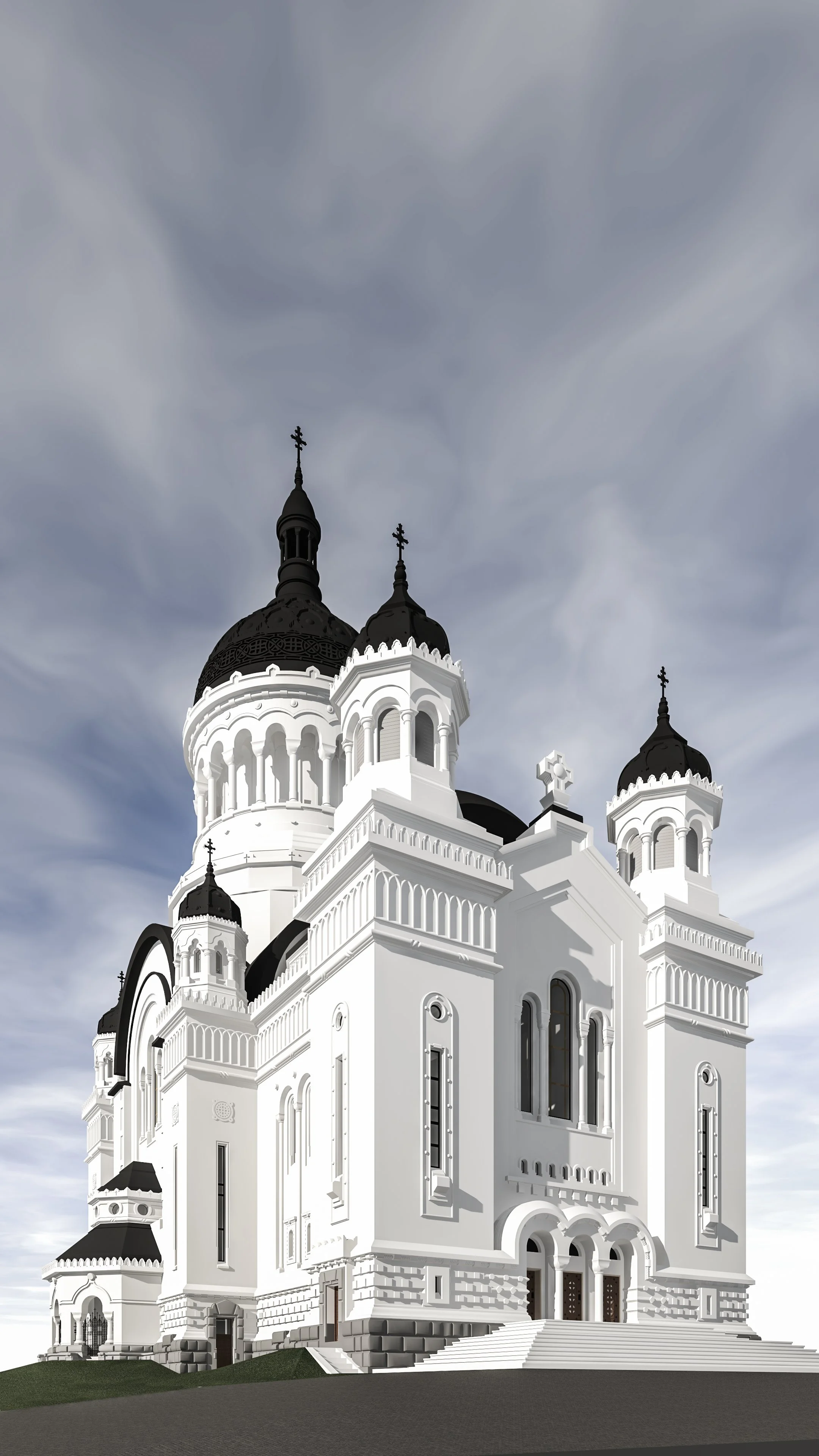
Construcția Catedralei Mitropolitane din Cluj-Napoca, purtătoare a hramului ‘Adormirea Maicii Domnului’, a început în anul 1923, datorându-se în mare măsură eforturilor episcopului Nicolae Ivan. Realizată după proiectul arhitecților Constantin Pomponiu şi Georges Cristinel, Catedrala este înscrisă în Lista Monumentelor şi Siturilor Istorice a Judeţului Cluj cu codul LMI: CJ-II-m-B-07354. Importanța acestui edificiu - și a celor similare lui - este surprinsă de către Prof.dr.arh. Augustin Ioan (2018) în cele ce urmează: ‘Biserica majorității populației este deci privită ca biserică națională (cu biserica greco-catolică a doua în rang) și, deci, ca motor al propagării ideii naționale, menite să unifice și să omogenizeze asperitățile statului național. Implementarea marilor catedrale ale românității ortodoxe în Transilvania a fost de aceea un gest de putere explicit. Practic, abia deceniile al patrulea și al cincilea sunt cele care încep să ridice, și din punct de vedere conceptual, problema expresivității - obligatoriu 'naționale' - a arhitecturii sacre, mai cu seamă a celei de scară monumentală, a catedralelor, […]’
Proiectul 'Reabilitare, restaurare și introducere în circuitul turistic a Catedralei Mitropolitane din Cluj-Napoca’, dezvoltat de biroul clujean ateliercetrei, propune definirea unei strategii holistice de restaurare, reabilitare și întreținere a monumentului istoric - vizând aducerea catedralei la o situație care nu mai presupune intervenții modificatoare, precum și introducerea acesteia în circuitul turistic. În acest sens, se propune transformarea dublei galerii pe colonete - elementul caracteristic principal a cupolei cu lanternou, elementul dominant al catedralei - în spații accesibile publicului larg. Procesul de digitalizare al monumentului (scanare laser și modelare informațională în trei dimensiuni) a scos la iveală un set de spații secundare - ascunse privitorului - aflate între pereții interiori si cei exteriori ai catedralei. Aceste spații vor găzdui traseul de vizitare - format dintr-un pachet de scări si platforme - care va facilita vizitarea dublei galerii pe colonete și implicit apropierea neobișnuită de cupola de peste naos care marchează legătura dintre cer și pământ - universul atotcuprinzător - prin cheia de boltă care este Iisus Pantocrator. În plus, galeria exterioară va oferi o priveliște panoramică inedită asupra orașului si împrejurimilor acestuia.